



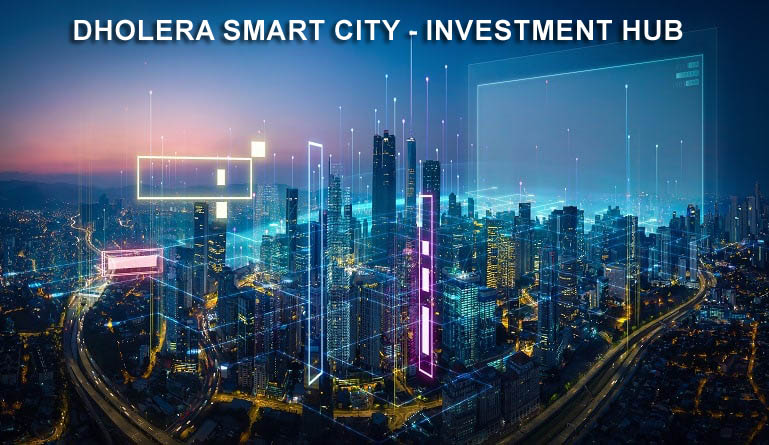
Explain the Vision for Dholera Smart City: India’s Premier Greenfield Development
Dholera Special Investment Region (SIR), located approximately 100 km southwest of Ahmedabad in Gujarat’s Ahmedabad district, is emerging as India’s premier greenfield smart city and a global hub for manufacturing and trade. To explain the vision for Dholera Smart City comprehensively, one must understand its ambitious scope: spanning over 920 square kilometers, Dholera SIR is a cornerstone of the Delhi-Mumbai Industrial Corridor (DMIC), a collaborative initiative between the Governments of India and Japan aimed at fostering industrial growth and economic resurgence. Envisioned to be larger than Singapore and six times the size of Shanghai, Dholera is designed to redefine urban development with world-class infrastructure, sustainable planning, and a business-friendly environment.
Strategic Location and Connectivity
DholeDholera’s strategic positioning in the Gulf of Khambhat enhances its appeal as a global investment destination. The region is well-connected to major industrial cities like Ahmedabad, Vadodara, Rajkot, and Bhavnagar, with seamless access to trade gateways. Key connectivity features include:
- Road Infrastructure: National Highway 8 links Dholera to Ahmedabad, Bhavnagar, and Mumbai, while a 250-meter-wide, 10-lane Central Spine Expressway and a six-lane access-controlled expressway connect Dholera to Ahmedabad.
- Rail Network: A high-speed metro rail project is under development to link Dholera with Ahmedabad and Gandhinagar, complemented by the Delhi-Mumbai Dedicated Freight Corridor (DFC) for efficient logistics.
- Air and Sea Access: The Dholera International Airport, spanning 1,426 hectares with a 3,200-meter runway, is being developed to alleviate traffic from Ahmedabad’s Sardar Vallabhbhai Patel International Airport. Additionally, a greenfield port, promoted by Dholera Port Limited (a joint venture by J K Group and Adani Group), is planned to bolster maritime trade.
These connectivity projects, expected to be completed within the next two to three years, position Dholera as a logistics and trade powerhouse.
Vision and Development Plan: The Core of Dholera Smart City
To truly explain the vision for Dholera Smart City, we must examine its foundational objectives and development framework. The vision for Dholera SIR is to create a self-governing global center for economic activities supported by cutting-edge infrastructure. The development plan, aligned with DMIC objectives, focuses on doubling employment potential, tripling industrial output, and quadrupling exports within five years. The city is divided into 12 zones and six sub-centers, including industrial, residential, commercial, knowledge and IT, logistics, and recreational areas.
Governance and Implementation
The Dholera Special Investment Region Development Authority (DSIRDA), established under the Gujarat Special Investment Region Act of 2009, oversees planning and land management. A Special Purpose Vehicle (SPV), Dholera Industrial City Development Ltd. (DICDL), formed in 2016 with 51% ownership by the Gujarat government and 49% by the central government, manages the project’s implementation. The initial 22.54 sq km “Activation Area” is nearly complete, with 95% of Phase-I infrastructure, including 72 km of roads, in place.
Smart Infrastructure Approach
When we explain the vision for Dholera Smart City’s infrastructure model, the plug-and-play approach stands out as innovative and investor-friendly. The city offers ICT-enabled land parcels with pre-built infrastructure to streamline business setup, eliminating delays and reducing initial setup costs for enterprises.
Sustainability at the Heart of the Vision
Sustainability is a core focus when you explain the vision for Dholera Smart City. The city features a zero-waste discharge water and wastewater system, ensuring environmental protection while meeting growing urban needs. The 5,000 MW Dholera Solar Park, India’s largest solar installation, drives renewable energy goals and positions Dholera as a leader in green urban development. This commitment to sustainability demonstrates that economic growth and environmental responsibility can coexist harmoniously.
Investment and Economic Impact
Dholera SIR is attracting significant investments, reflecting growing confidence in its potential. Annual real estate investments range from ₹2,000-3,000 crore, primarily from northern Indian states like Punjab, Haryana, Delhi, Gurugram, and Noida. Major conglomerates are also investing heavily:
Adani Group: Developing logistics parks and a multi-modal logistics hub to enhance transportation and trade capabilities.
Tata Group: Exploring opportunities across diverse sectors, contributing to Dholera’s industrial ecosystem.
Vedanta-Foxconn JV: Investing INR 1.54 trillion (US$18.65 billion) to establish India’s first semiconductor and display manufacturing facility, hailed as the largest corporate investment in independent India’s history.
Tata Electronics: Collaborating with Synopsys for a $10.9 billion semiconductor fabrication plant.
Other investors, including Cisco, IBM, Mitsubishi, Hitachi, and Vedanta Limited, are focusing on sectors like IT, manufacturing, and aluminum production. The presence of these industry leaders is expected to create a ripple effect, attracting further investments and fostering a robust business ecosystem.
Economic Goals and Job Creation
The region’s economic goals are central to understanding the vision for Dholera Smart City. The project aims to create 8 lakh jobs and house 20 lakh inhabitants by 2040. Phase-I, covering 22.5 sq km, is projected to cost ₹4,400 crore, with 52% allocated to industrial use and 28% to residential areas. This balanced approach ensures that Dholera develops as a complete ecosystem rather than just an industrial zone.
Infrastructure and Smart City Features
Dholera SIR is designed as a smart city with state-of-the-art infrastructure and sustainable urban planning. To explain the vision for Dholera Smart City’s infrastructure in detail, key features include:
Urban Planning: Six town planning schemes cover 422 sq km, with Town Planning Schemes 5 and 6 spanning 75 sq km and 67 sq km, respectively. The city includes mixed-use zones for residential, commercial, and institutional purposes, creating vibrant neighborhoods where people can live, work, and play.
Smart Networking: Cisco has completed an international-level ICT plan, ensuring seamless digital connectivity across the entire smart city. This digital backbone enables efficient governance, smart utilities, and enhanced quality of life for residents.
Residential and Commercial Projects: Developers like Aaiji Group have completed projects such as Aaiji Airport Villa and Aaiji Residency, with more under development. Residential plots start at 200 sq m, catering to diverse housing needs and making the vision accessible to various income segments.
Hospitality: A 12,095 sq m plot for a 5-star hotel was allocated in 2023, with an e-auction held in June 2023, demonstrating the growing commercial viability of the region.
Despite its flood-prone location, extensive planning, including Phase-I flood management, mitigates environmental risks and ensures sustainable development.
Challenges and Criticisms Addressed
While Dholera SIR has gained momentum, it has faced challenges that are important to acknowledge when we explain the vision for Dholera Smart City objectively. Land acquisition from farmers has been contentious, and the region’s low-lying, flood-prone terrain raised concerns, particularly after severe waterlogging in August 2019. Early investors, including Hindustan Construction Company and Universal Success Group, withdrew due to economic viability concerns.
However, recent infrastructure progress and high-profile investments have shifted perceptions, with the project now seen as a viable investment destination. The government’s commitment to completing infrastructure and attracting anchor industries like semiconductor manufacturing has restored investor confidence.
Global Interest and Future Prospects
To explain the vision for Dholera Smart City in a global context, it’s essential to note the international attention it’s garnering. Dholera SIR is attracting worldwide interest, with South Korean firms exploring opportunities in 2023 and Singapore’s Consul visiting in April 2025 to discuss master planning. Partner countries like the USA, UK, Singapore, France, China, and Korea are engaged in the project, enhancing its global appeal and bringing international best practices to India’s smart city development.
Forbes magazine has recognized Dholera as one of the world’s most developing cities, highlighting its investment potential. With infrastructure nearing completion and major projects like the semiconductor fab and solar park underway, Dholera is poised to become a global manufacturing and trading hub, rivaling cities like Shenzhen and Singapore.
Conclusion: A Vision Taking Shape
Dholera SIR represents a bold vision for India’s economic future, combining cutting-edge infrastructure, sustainable urban planning, and a business-friendly ecosystem. When asked to explain the vision for Dholera Smart City, the answer encompasses multiple dimensions: it’s a commitment to sustainable development, an ambition to create a global manufacturing hub, a promise of economic opportunity for millions, and a blueprint for how Indian cities can evolve in the 21st century.
Backed by significant investments from domestic and international players, the region is transforming from an ancient port town into a modern smart city. While challenges remain, the project’s strategic location, robust connectivity, and government support position it as a high-potential investment destination. As Dholera SIR continues to develop, it is set to play a pivotal role in India’s journey toward becoming a global economic powerhouse, demonstrating that with proper planning, investment, and execution, India’s smart city vision can become reality.
For more information on investment opportunities, visit Dholera SIR Official Website or National Industrial Corridor Development Corporation.


